
Mahila Samriddhi Yojana
With the objective to encourage women entrepreneurs and give impetus to their business journey, the Ministry of Social Justice and Empowerment, the Government of India has implemented a strategic policy – Mahila Samridhi Yojana. Under the visionary scheme, the government provides microfinance to women entrepreneurs hailing from marginalized sections of the society – backward classes. Designed considering women’s empowerment, the flagship scheme is being implemented by a wide range of channel partners nationwide. Targeted women beneficiaries are identified and given loans either directly or in the form of Self-Help Groups (SHGs).
The guidelines under the Mahila Samridhi Yojana (MSY) clearly signify that the loan to the tune of 95% will be sanctioned, while the balance 5% will be funded by the State Channelizing Agencies (SCAs) or beneficiary contribution. Guidelines indicate that the utilization period for the loan received is 4 months, starting from the date of disbursement of the loan.
| Limit of Loan | Interest Chargeable | |
| Rs. 1,40,000 per beneficiary | SCA | Beneficiary |
| 1% per annum | 4% per annum |
Loan Repayment Tenure: 3 years and 6 months
Moratorium Period: 3 months
Eligibility
As the MSY scheme is dedicated to bringing about a turnaround in the lives of women belonging to the marginalized sections of the society, stringent eligibility criteria is in place to ensure fair disbursal of the loan. The eligibility criteria comprise:
- SHGs and women entrepreneur from backward sections of the society are only eligible to draw the benefit of MSY loan
- Woman beneficiary of the minimum age of 18 years
- Beneficiary falling under the BPL category
- Annual income of the beneficiary should be less Rs. 3 lakh per annum
- No criminal past record
Any kind of misrepresentation or fudging of data might lead to the rejection of an application.
Documents Required
The MSY loan has been receiving an overwhelming response from the women hailing from every nook and corner of the country. There are plenty of reasons to corroborate the fact, minimal documentation is one among them. The following documents are required to avail the loan facility intended to empower women and lift their socio-economic status:
- Proof of Identity – Voter ID card
- Self-group membership ID card
- Income certificate issued by the competent authority
- Filled in the application form to obtain the Mahila Samridhi Yojna loan
- Aadhaar card
- Caste certificate issued by the competent authority
- Bank account book
- Passport size photograph
- Proof of residence (Electricity bill or ration card can be furnished)
As the MSY loan is intended for the backward sections, it has come to light, a substantial number of women beneficiaries have lifted their socio-economic status.
Features & Benefits
The flagship scheme of the Ministry of Social Justice and Empowerment, the Government of India has been instrumental in transforming the lives of hundreds of women across India. Some of the benefits include:
- Lifts the socio-economic condition of the beneficiary
- Plays a role in mainstreaming of the poverty-ridden family
- Supports in generating employment opportunities
- Cultivates entrepreneurship among women
- Empowers the women, make them self-reliant
- Minimal documentation
- Raises the self-belief in women
Other Significant Information
Self Help Groups (SHGs): Economically aligned group of people who voluntarily develop a group to raise their income by saving and contributing to group activities.
Channel Partners: Channel partners are represented by competent professionals in the field; help the group and its members in economic activities and in availing the MSY loan.
Member Ration: As per the rules and regulations, maximum women members allowed in an SHG are – 20. The 75% of members should be from the backward classes as mandated by the eligibility criteria, while the remaining 25% of women members could be from other weaker sections – Scheduled Caste or physically handicapped.
Loan Disbursal: Loan is disbursed through the State Channelizing Agencies (SCAs), Regional Rural Banks (RRBs) and the nationalized banks to the beneficiaries.

Mahila Udyam Nidhi Scheme
Mahila Udyam Nidhi (MUN) Scheme is a scheme offered under the Small Industrial Development Bank of India (SIDBI) to encourage and empower women entrepreneurs and promote women Entrepreneurship by providing financial assistance at concessional interest rates. The funding provided by Mahila Udyam Nidhi Scheme can be used by MSMEs to undertake service, manufacturing and production-related activities.
Under Mahila Udyam Nidhi Scheme, women entrepreneurs can avail loans up to Rs. 10 lakh to start their own business or small scale enterprise. The interest rates offered under this scheme may vary from bank to bank. The funding support can also be used to upgrade or expand existing projects. The maximum loan repayment period offered under this scheme is up to 10 years with the moratorium pages up to 5 years.
Eligibility Criteria
Women entrepreneurs who have initiated existing and new MSMEs, Tiny Units or SSIs Financial holding of women entrepreneurs should not be less than 51%, engaged in manufacturing and production purposes Existing or new MSMEs engaged only in services, trading and manufacturing sectors MSMEs or tiny enterprises with a minimum investment of at least Rs. 5 lakh MSMEs engaged in various activities, such as business expansion, improvement, diversification, and technology upgradation.
Features of Project Profile
- Project cost must not exceed Rs. 10 lakh
- Loan limit of up to 25% of project cost, subject to a maximum of Rs. 2.5 lakh per project is offered to deserving women entrepreneurs
- Repayment tenure of the loan is up to 10 years, including a moratorium period of 5 years
- Interest rates fixed by SIDBI and offered by banks may vary from time to time and shall be communicated by SIDBI to women entrepreneurs
- Service charge of 1% per annum is charged by the respective bank, as per the sanctioned loan
- Service charge waiver depends on the lending office
Benefits of Mahila Udyog Nidhi Yojana
- Promotes women entrepreneurs
- Increases employment opportunities in the tiny and small scale sectors
- Helps to meet the gap in equity
- Rehabilitates weak SSI units
- Expansion, modernization and technology upgradation of service industries
Activities included in Mahila Udyam Nidhi Scheme are as follows:
- Auto-repairing and servicing centre
- Beauty parlour
- Cable TV Network
- Canteen and Restaurant
- Computerized Desktop publishing
- Crèche
- Cyber Café
- Daycare centre
- ISD / STD Booth
- Laundry & Dry Cleaning
- Mobile Repairing
- Photocopying (Xerox) Centre
- Purchase of auto-rickshaws, two-wheelers, cars
- TV Repairing
- Road transport operator
- Salon
- Servicing of Agricultural and Farm equipment
- Tailoring
- Training Institute
- Typing Centre
- Washing machines and other electronic and electrical gadgets, etc.
Mahila Udyam Nidhi Scheme was first launched by Punjab National Bank to provide funding support to women entrepreneurs who are engaged in SSIs. However, there are several banks that offer Mahila Udyam Nidhi Scheme at affordable and attractive interest rates. Moreover, there is no collateral or security to be submitted by the women entrepreneurs to start their enterprise. This scheme helps women entrepreneurs to start their own businesses and promotes them to grow and expand in their areas of interest and skills.
Like Mahila Udyam Nidhi Scheme, there are various other schemes that promote and help in the development and growth of women entrepreneurship that include Mudra loan scheme, TREAD (Trade-Related Entrepreneurship Assistance and Development) scheme, Cent Kalyani Scheme, Udyogini Scheme, Dena Shakti Scheme, Annapurna Scheme, Stree Shakti Package for Women Entrepreneurs, etc.

Business Loan
Business loan is a credit facility offered by Banks and NBFCs to meet the financial requirements of self-employed customers and enterprises. It can be availed by individuals, MSMEs, business owners, entrepreneurs, professionals (CAs/Doctors), and several other business entities.
Business loans are majorly classified into two types, such as secured loans and unsecured loans. Secured loans are types of loans that require collateral/security, that a borrower needs to deposit with the lender to avail a business loan. However, in the case of unsecured loans, there is no need to submit any collateral/security with the bank, NBFC, or any other lender.
Banks/NBFCs offer both secured and unsecured business loans, including Term Loan (Short-term/Long-term), Working Capital Loans, Cash Credit, Overdraft, Letter of Credit, Bill/Invoice Discounting, Equipment Finance, Machinery Loans, POS loans, Loan under Bank Guarantee, Loan under Govt. schemes, etc.
The minimum loan amount offered starts from as low as Rs. 30,000 that can be availed from Small Finance Banks (SFBs), Regional Rural Banks (RRBs), or Micro Finance Institutions (MFIs). Borrowers can avail collateral-free business loans for up to Rs. 1 crore from leading private and public sector banks. Small business loans are also available for MSMEs and Startups at competitive interest rates.
On our online platform, the business loan interest rates offered by financial institutions start from 16% p.a. onwards and are further determined as per the applicant’s profile, eligibility & business requirements. Below mentioned are the business loan interest rates offered by leading banks and NBFCs.
| Bank/NBFC/Fintech | Interest Rate |
| IIFL Finance | 11.75% – 25.75% p.a. |
| HDFC Bank | 11.90% – 21.35% p.a. |
| FlexiLoans | 1% per month onwards |
| ZipLoan | 1% – 1.5% per month (Flat ROI) |
| Axis Bank | 14.25% – 18.50% p.a. |
| IDFC First Bank | 14.50% p.a. onwards |
| Kotak Mahindra Bank | 16% – 19.99% p.a. |
| Fullerton Finance | 17% – 21% p.a. |
| Bajaj Finserv | 17% p.a. onwards |
| RBL Bank | 17.50% – 25% p.a. |
| ICICI Bank | 18% p.a. onwards |
| Indifi Finance | 1.5% per month onwards |
| Lendingkart Finance | 1.5% – 2% per month |
| Tata Capital Finance | 19% p.a. onwards |
| NeoGrowth Finance | 19% – 24% p.a. |
| Hero FinCorp | Up to 26% p.a. |
Interest Rates are updated as on April 2022.
Credit Scores
Credit score plays a significant role in the loan approval process. It represents your credit history along with the repayment timeline of availed funding products. Generally, any credit score of 750 or more is considered good by the financial institutions. However, if your credit score is bit low of 650 or above, there are still chances of loan approval from some NBFCs, Small Finance Banks and Micro Finance Institutions.
The credit score eligibility defined by financial institutions are different for individuals, self-employed professionals, MSMEs, retailers or manufacturers and other business entities.
Different ranges of credit score is required by banks/NBFCs, from borrowers who require various types of business loans, such as term loan, working capital loan, letter of credit, overdraft, POS loans, etc. The credit score range defined by the lender for a specific loan product shall vary from applicant to applicant and loan types.
People with New-to-Credit should also start to build a credit score for loan approvals, as applicants with low credit scores are always at higher risk of loan rejections. Startups require even higher credit scores to avail business loans and they are new to the lending market and are about to set up a new business. Therefore, build and maintain a good credit score to enhance the chance of loan approval.
Eligibility Criteria
- Business Tenure: Minimum 1 year or above
- Minimum Annual Turnover: Rs. 12 lakh or above for existing enterprises
- Credit Score: 750 or above
- Applicants with No past loan defaults
Eligible Entities
- Individuals, Business Owners, Entrepreneurs, Self-employed professionals, Startups and Micro, Small, and Medium Enterprises (MSMEs)
- Private and Public Limited Companies, Sole Proprietorship, Partnership Firms, Limited Liability Partnerships, and Large Enterprises engaged only in Manufacturing, Trading or Services sectors
- NGOs, Co-operative Societies, Trusts and professionals, such as CAs, Doctors, Architects, Company Secretaries, Designers, etc.
Documents Required
When applying for a business loan, you will need to submit the following documents:
- Duly filled application form along with passport-sized photographs
- KYC Documents of the applicant, including PAN card, Passport, Aadhar Card, Driving License, Voter ID card, Utility Bills (Water/Electricity Bills)
- Last 1 years’ bank statement
- Copy of Non-Collateral Overdraft, if any
- Copy of Business Incorporation
- Any other document required by the lender
How to write a Business Plan
Business plan is a formal written document that contains your prospective business goal. Business loan includes the process on how to execute these plans, the time period in which the goals have to be attained or executed. The plan consist a list of details which helps a business to achieve certain goals that helps them grow. Plans for attaining business loans also contain the following details:
- Nature of the business
- Background and financial flexibility of the enterprise or business
- All the strategies, business or company wants to undertake to achieve their target
- It works as a road map which provides a direction to the business
- Banks often require a documented business plan to sanction business plan or other kind of financial requirements
Components of a Business Plan
The process of making a good business plan requires the company or firm to stick to a particular structure or template used to make or draft business plans. Well written business plan includes the following:
- Cover page with complete index
- Pitch summary
- The motto or vision statement
- Brief description of the business
- Analysis of the business environment
- SWOT analysis
- Industry background
- Analysis of the competitors
- Market analysis
- Marketing plans
- Operational plans
- Management summary
- Financial planning
- Recent company’s success stories
How to write a Business Plan to Start Your own Business?
How to start a business plan has always been a confusing topic for many firms and organisations. Creating a perfect business plan can prove beneficial for the growth of the firm or business. Creating a business plan involves a lot of research and detailed process which include a lot of stages some of which overlap each other or are inter related. It doesn’t matter if you are drafting a business plan from scratch or a predefined template or working with a business plan writer or consultant, you will find these steps along the way:
- Research: Detailed research includes digging out information about customers, competitors, and a detailed report about working capital cost of the business. A variety of methods can be used to find the following data; the data can be extracted from a variety of methods ranging from articles and data bases to even arranging interviews with other entrepreneurs or even potential customers. Research has to be organised and documented carefully with all the information gathered. The source of the information is to be documented along with the information, as the source has to be mentioned within the business plan
- Strategizing: The information that has been collected has to be used relevantly to support your business plan. Revise the business strategy you planned according to the information gathered. Your research has to be in-depth and precise so that your strategy can provide support to your decision on appropriate marketing, operations of the business or the firm. The rate at which the company shall hire for five years has to be mentioned. Strategy usually pulls the best out the practises present in the current marketing scenario. The companies use this as a base to build a plan in which different activities are added that gives the business a competitive advantage
- Calculation: All the activities and improvement comes at a cost and will generate some revenue from the strategy. The strategy has to be made with the cost of execution and the profits in the long. The strategy has to be on the basis that the profit would cover up the expenses. Start inserting your start-up cost and financial assumptions into a financial model which will provide you with an overview on the flow of cash in the first financial year, this will give an estimate on the funds the business will need on hand to fund the early operations
- Draft: With the strategy more or less decided and an estimate of the provided it is time to draft a business plan. With all the research and the calculations done properly the drafting work is the easiest in the creation of a business plan. If there is a problem in putting forward a convincing prose then this might be the right time to consult or seek the help of a business plan writer who can put together the business plan
- Revision and proofreading: Revising the entire business plan will ensure that you haven’t missed any idea or strategy that was to be added while drafting the business plan. Check whether the words in the business plans do not lead to any confusion. Repetitive, irrelevant or redundant points should be removed or substituted with better ideas that suits the points in the business plan. Finally go through the business plan to find grammatical errors, spelling mistakes and formatting
Types of Business Plans
There are two types of business plans as mentioned below:
A) Internally focused business plan
B) Externally focused business plan
Let’s discuss about these two types in detail.
1. Internally Focused Business Plan
It is a business plan which focuses on the internally focused business targets, intermediate goals which help an organisation to reach their externally focused business plans. An internally focused business plan may contain details like a new service that has been added in the business, a line of new products that the company is going to launch, the restructures in the financial matters of the company, setting up of a new IT system or even the restructuring or renovation of the business or the company. It usually contains a list of recent success the company has achieved.
2. Externally Focused Business Plan
Externally focused business plans which contain detailed information about the organisation or the company or the efforts made by a team to reach their goals. It also contains various list of profit entities, it includes a list of external stakeholders which include investors and customers of the company.
There are different types of externally focused business plans which have different stakeholders, investors and customers. The various types of externally focused business plan are as follows:
- Non-profit based: the external stakeholders are clients and donors
- Profit based: external stakeholders are investors and customers
- Government agencies: external stakeholders are the higher level government bodies, taxpayers, or the international lending bodies. The international lending bodies include international monetary funds, the World Bank and development banks.
FAQs
Ques. What are the questions that are answered by a perfect business plan?
Ans. The questions are as follows;
- What makes you different?
- How is your business going to make money?
- What are the ways to promote your business?
- What is the amount of funds required to get started?
- What is the expected time period to cover your investments?
Ques. How long should be a business plan?
Ans. A business plan can be anywhere near 10 to 100 pages; it always depends on the purpose of the business plan.
Ques. Is it mandatory to write a business plan?
Ans. In case you are interested in taking business loan from a financial institution, then it becomes essential to write a business plan as it is required by lenders before sanctioning any loan.
Ques. Who should write my business plan?
Ans. It is your business so the plan also needs to be written by you ‘the entrepreneur’.
Ques. What are the common mistakes in writing a business plan?
Ans. There are some of the common mistakes in writing a business plan that include ignoring the competition in the entering market, copying an exact plan of someone else, being over optimistic, relying on limited customers, applying too many ideas, etc.
What is a Project Report
For taking a business loan from the bank for a new start-up business, the borrower must represent the project report of their business. All the necessary requirements and official documents have to be submitted with the project report. The project report should be such that it should represent the idea of the whole business and can be easily understood by the reader.
Elements of Project Report
Let’s discuss the standard format for the project report for bank loans of new businesses.
Introductory page
- On this page, the introduction of your new business is to be given
- The aim of the business and on what purpose you have chosen this business all these points should be mentioned in this introductory part
Summary of the project
- Summary of the project should consist of the overall status of the business
- Time to be consumed in working or manufacturing something should be there
- The budget of the whole business should also be mentioned
Scope of the project
- Scope of your business should be clearly described
- It should contain the percentage of work that you planned and the percentage of planned work that has already been completed
- Quick overview of results and planning of next steps should be included
Details of Promoters
- The promoters are the mediator for the business which helps for the promotion of the business
- The details of the promoters and their educational qualifications and work experiences etc. should also be given in the report
Details of Employees
- The details about the employees working this business should be written
- Their educational qualifications should also be mentioned
- The work experiences and details about the top management should also be written
Infrastructure Facilities
- Information about infrastructure facilities should also be mentioned like whether the tools have been deployed or not
- Also, write about the conditions of the operational premises and what all are used
- Types of machinery used in the business should also be mentioned
Customer Details
- Information about customers should be well written like, what are the types of customers you have targeted for selling your business items
- The prospective customer’s details should also be mentioned like is they from the big organization and also what is their capacity of buying goods in this business
Regional Operations
- Many times a company opens branches in different areas or regions. The branches may be set up nationally and internationally, as per the requirements
- When you make a project report you have to write about the different setups you made in which region and also write about the operation teams
Fiscal Acquisitions and Tie-ups
- You have to write it down in the project report with whom you have done tie-up or which stock or acquisition you have taken and all details of it should be mentioned in the report
Means of Financing
- The financing in the business can be done by the financial corporation or the business partners or somewhere else
- So, it is very important that from where the funding is coming, so this all should be mentioned in the report
Balance Sheets
- Balance sheets tell about where the money has been spent
- Also in what areas and fields the spending has been done is also noted. Thus all the accounts of the business will be seen in this balance sheet
- It is important to show the balance sheets of your company to the bank and it should also be mentioned in the report
Profit and Loss Statements
- How much the profit will company make and how much profit is making the business has to be in the report
- Whether the business is making any profit or loss the statements should be shown to the bank and also being mentioned in the report
Fund Flow Statement
- The funding given by any corporate or government and where it is used and in what fields of business the funding is flowing should be mentioned in the project report
Break-Even Points Evaluations
- Give the evaluations of the whole project report in even points and mention everything about your whole business
- Project Feasibility Ratio: Deciding on the ratio of cost, discounts, and revenue
Project Feasibility Ratio
Project Feasibility Ratio is basically deciding on the ratio of cost, discounts, and revenue of an enterprise. It can be presented in the form of a graph by mentioning the year-on-year comparison between revenue and expense. The project report should also contain the expense split-up graph.
The components of Project Feasibility Ratio are below mentioned that are required to be displayed as per year-on-year comparison:
- Current ratio
- Quick ratio
- Interest coverage ratio
- Debt equity ratio
- Gross profit Sales Percentage
- Net profit Sales Percentage
- Return On Capital Employed
Scope of the project
The scope of the project should have below mentioned details:
- Promoter(s) details
- Product / services & process
- Plant & machinery / equipment
- Market potential & Strategy
- Manpower requirements
- Risks & Mitigation strategy
FAQs
Ques. Is it necessary to make a project report for a bank loan?
Ans. The project report is very much necessary when you’re going to take a business loan for your business.
Ques. What are the necessary contents used in the project report?
Ans. The necessary contents preparing in project reports are:
- Introductory page
- Summary
- Details about the promoters
- Details of employees
- Details about Infrastructure
- Details about customer
- Regional operations
- Fiscal acquisitions and tie-ups
- Means of financing
- Balance sheet
- Profit and loss statements
- Fund flow statements
- Break-even point evaluations
- Conclusion

Project Report (contd..)
SIDBI on its Portal Udyami Mitra, has hosted several Project Reports for the information and reference of prospective entrepreneurs. You can visit https://udyamimitra.in/page/project-reports to read those project reports.
Sample Project Reports
A entrepreneur requires to prepare Project Reports to study the viability, sustainability of his / her business. We are providing below sample Project Reports, which you can use as a reference point for preparation of your Sample Project Report.
Click here to View Sample Project Report

Entrepreneurial and Managerial Development of SMEs through Incubators
Objective
New Enterprise Creation
Key Benefits
Funding support up to Rs. 15 lakhs for development of innovative ideas in to commercial products
Seed funding support up to Rs. 100 lakhs for setting up new units for commercialization of successful innovative ideas
Scheme applicable for
Existing Entrepreneurs/Aspiring Entrepreneurs
Detailed Information
The main objective of the scheme is to promote & support untapped creativity of
individual and to promote adoption of latest technologies in manufacturing as well as
Knowledge based innovative MSMEs (ventures) that seek the validation of their ideas at the proof of concept level. The scheme also supports engagement with Enablers who will advise such MSMEs in expanding the business by supporting them in design, strategy and execution. The Enablers will play a pivotal role and would be integral part of the business development.How to apply : Click Here

Procurement & Marketing Scheme
Objective
Marketing Support
Key Benefits
Participation of Individual MSEs in domestic Trade Fair/ Exhibition
Capacity building of MSMEs in Modern Packaging Technique / Development of Marketing Haats.
Organizing Domestic Trade Fair& Exhibition/ Vendor Development Programs/ National & International Workshops & Seminars/ Awareness programs
Scheme applicable for
Existing Entrepreneurs
Detailed Information
Participation of individual MSEs in domestic trade fairs/ exhibitions across the country: Maximum Budgetary support (space rent and contingency) upto Rs.1.5 Lakhs max.for Metro & A class citers. Rs 1.0 lakhs max. for Class B cities / NER/J&K/ Hilly States and for other cities Rs.0.80 lakhs max.
Organizing Domestic Trade Fairs/ Exhibition and participation in trade fairs/exhibitions by the Ministry/Office of DC (MSME)/Government organizations:
Maximum Budgetary support for space rent and advt. & publicity for the event is as follows,
a. Regional :(State/District): Rs.30.00 Lakh max.
b. National: Rs.40.00 Lakh .max.
c. International: As decided by Empowered Committee subject to approval of Deptt. Of Expenditure.
Capacity building of MSMEs in modern packaging technique: Maximum Budgetary support of Rs.1.0 lakh max. for ordinary packaging consultancy and Rs.1.5 lakh max. for green packaging consultancy for MSME unit.
Development of Marketing Haats. Maximum Budgetary support: For Development of new MSME Haats, upper limit of GIA will not exceed Rs. 50 lakh max.
For Renovation/up-gradation of existing Marketing Haats, upper limit of GIA will not exceed Rs.20 lakhs max.
Vendor Development Programmes: Maximum Budgetary support is as follows; State Level Vendor Development Programme (SLVDP): Rs. 1 Lakh max. (One day) National Level Vendor Development Programme (NLVDP): Rs. 10 lakhs max. for A class city and Rs.7.0 lakh max. for other cities. (2-3 days)
International/National Workshops/Seminars.: Maximum Budgetary Support would be Rs 5.0 lakh maximum or actual whichever is less and for National Workshop/Seminar and Rs 7.5 Lakh maximum or actual whichever is less for International Workshop/Seminar
Awareness Programs: Maximum Budgetary support of Rs. 70,000/- max. per program (One day)
How to apply Click Here
2nd Loan for up-gradation of the existing PMEGP/MUDRA units
Objective
Technology up-gradation and expansion of existing units through credit support
Key Benefits
To fulfill the need of additional financial assistance for upgradation and expansion of successful/well performing existing units
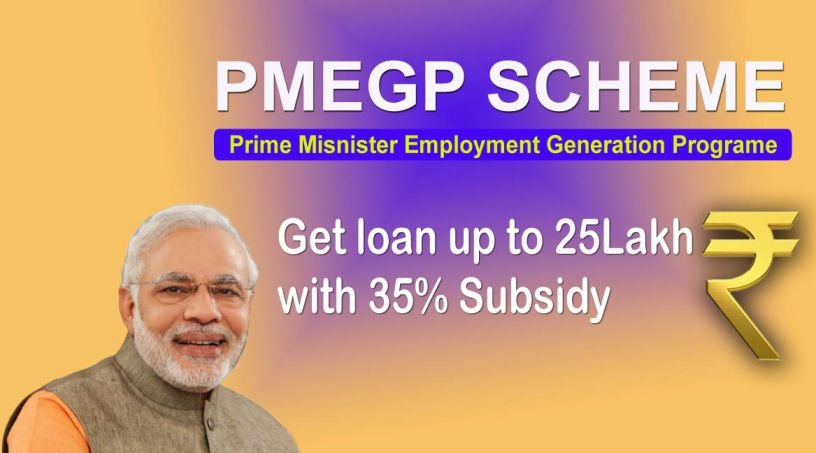
Maximum subsidy would be 15% of the project cost (20% for NER and Hill States). The balance amount of the total project cost is provided by Banks as term loan.
Scheme applicable for
Existing well performing PMEGP/MUDRA units
Detailed Information
Further financial assistance scheme for expansion/upgrade the existing PMEGP/MUDRA units for manufacturing and Service/Trading units from the year 2018-19
The maximum cost of the project under manufacturing sector for up-gradation is Rs.1.00 crore and Rs.25.00 lakh under Service/Trading sector.
Maximum subsidy would be 15% of the project cost (20% for NER and Hill States) i.e. Rs. 15.00 lakh in Non-NER and Rs. 20.00 Lakh for NER and Hill States. The balance amount of the total project cost are provided by Banks as term loan.
All existing units financed under PMEGP/MUDRA schemes running successfully whose Margin Money claim has been adjusted and the First loan (only CE) availed should have been repaid in stipulated time and WC may be exempted.
The units should have been making profit for the last three years.
Beneficiary may apply to the same financing bank, which sanctioned the loan for their unit, or to any other financing bank, which is willing to extend credit facility for second loan.
The beneficiary can choose any implementing agency and that may be different from the agency chosen for 1st loan.
Registration of Udyog Aadhar Memorandum (UAM) is mandatory.
The 2nd loan should lead to additional employment generation.
On PMEGP e-Portal, a separate application link provided to submit the application under 2nd loan for up-gradation.
How to apply Click Here