Procurement & Marketing Scheme
Objective
Marketing Support
Key Benefits
Participation of Individual MSEs in domestic Trade Fair/ Exhibition
Capacity building of MSMEs in Modern Packaging Technique / Development of Marketing Haats.
Organizing Domestic Trade Fair& Exhibition/ Vendor Development Programs/ National & International Workshops & Seminars/ Awareness programs
Scheme applicable for
Existing Entrepreneurs
Detailed Information
Participation of individual MSEs in domestic trade fairs/ exhibitions across the country: Maximum Budgetary support (space rent and contingency) upto Rs.1.5 Lakhs max.for Metro & A class citers. Rs 1.0 lakhs max. for Class B cities / NER/J&K/ Hilly States and for other cities Rs.0.80 lakhs max.
Organizing Domestic Trade Fairs/ Exhibition and participation in trade fairs/exhibitions by the Ministry/Office of DC (MSME)/Government organizations:
Maximum Budgetary support for space rent and advt. & publicity for the event is as follows,
a. Regional :(State/District): Rs.30.00 Lakh max.
b. National: Rs.40.00 Lakh .max.
c. International: As decided by Empowered Committee subject to approval of Deptt. Of Expenditure.
Capacity building of MSMEs in modern packaging technique: Maximum Budgetary support of Rs.1.0 lakh max. for ordinary packaging consultancy and Rs.1.5 lakh max. for green packaging consultancy for MSME unit.
Development of Marketing Haats. Maximum Budgetary support: For Development of new MSME Haats, upper limit of GIA will not exceed Rs. 50 lakh max.
For Renovation/up-gradation of existing Marketing Haats, upper limit of GIA will not exceed Rs.20 lakhs max.
Vendor Development Programmes: Maximum Budgetary support is as follows; State Level Vendor Development Programme (SLVDP): Rs. 1 Lakh max. (One day) National Level Vendor Development Programme (NLVDP): Rs. 10 lakhs max. for A class city and Rs.7.0 lakh max. for other cities. (2-3 days)
International/National Workshops/Seminars.: Maximum Budgetary Support would be Rs 5.0 lakh maximum or actual whichever is less and for National Workshop/Seminar and Rs 7.5 Lakh maximum or actual whichever is less for International Workshop/Seminar
Awareness Programs: Maximum Budgetary support of Rs. 70,000/- max. per program (One day)
How to apply Click Here
2nd Loan for up-gradation of the existing PMEGP/MUDRA units
Objective
Technology up-gradation and expansion of existing units through credit support
Key Benefits
To fulfill the need of additional financial assistance for upgradation and expansion of successful/well performing existing units
Maximum subsidy would be 15% of the project cost (20% for NER and Hill States). The balance amount of the total project cost is provided by Banks as term loan.
Scheme applicable for
Existing well performing PMEGP/MUDRA units
Detailed Information
Further financial assistance scheme for expansion/upgrade the existing PMEGP/MUDRA units for manufacturing and Service/Trading units from the year 2018-19
The maximum cost of the project under manufacturing sector for up-gradation is Rs.1.00 crore and Rs.25.00 lakh under Service/Trading sector.
Maximum subsidy would be 15% of the project cost (20% for NER and Hill States) i.e. Rs. 15.00 lakh in Non-NER and Rs. 20.00 Lakh for NER and Hill States. The balance amount of the total project cost are provided by Banks as term loan.
All existing units financed under PMEGP/MUDRA schemes running successfully whose Margin Money claim has been adjusted and the First loan (only CE) availed should have been repaid in stipulated time and WC may be exempted.
The units should have been making profit for the last three years.
Beneficiary may apply to the same financing bank, which sanctioned the loan for their unit, or to any other financing bank, which is willing to extend credit facility for second loan.
The beneficiary can choose any implementing agency and that may be different from the agency chosen for 1st loan.
Registration of Udyog Aadhar Memorandum (UAM) is mandatory.
The 2nd loan should lead to additional employment generation.
On PMEGP e-Portal, a separate application link provided to submit the application under 2nd loan for up-gradation.
How to apply Click Here

Credit Guarantee on Loans to Micro and Small Enterprises and New Entrepreneurs
Eligibility & Conditions:
Existing Micro, small and service Entrepreneurs & Aspiring Entrepreneur all are eligible
Nature of Scheme:
The scheme is implemented by Credit Guarantee Trust for MSE (CGTMSE);
Credit guarantee for loans upto Rs. 2.00 crore, without collateral and third party guarantee;
Guarantee coverage ranges from 85% (Micro Enterprise up to Rs 5 lakh) to 75% (others);
Recently, guarantee coverage made eligible to select NBFCs and Small Finance banks;
The extent of guarantee cover is 50% of the sanctioned amount of the credit facility for credit from
Rs. 10 lakh to Rs. 100 lakhs per MSE borrower for retail trade activity.
The extent of guarantee cover is 80% for (i) Micro and Small Enterprises operated and/or owned by women; and (ii) all credits/loans in the North East Region (NER) for credit facilities upto Rs. 50 lakh.
In case of default, CGTMSE settles the claim with the lending institutions.
Steps for Availing the Assistance:
Apply through Member Lending Institutions (MLIs- Banks and NBFCs).
List of MLIs are available at http://www.cgtmse.in
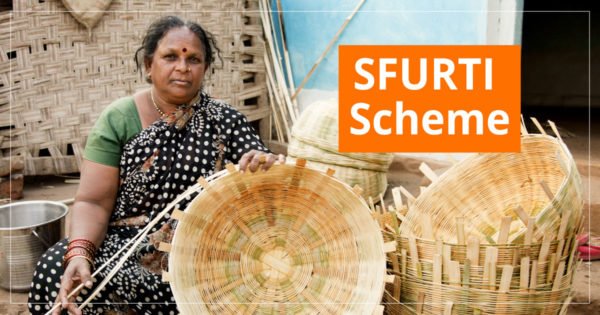
SFURTI Scheme
OBJECTIVES OF SFURTI SCHEME
The objectives of the Scheme are as follows:
i. To organize the traditional industries and artisans into clusters to make them competitive and provide support for their long term sustainability and economy of scale;
ii. To provide sustained employment for traditional industry artisans and rural entrepreneurs;
Detailed Guidelines : Click here

Gram Vikas Yojana
Eligibility & Conditions:
Target beneficiary: Artisans, Unemployed Youth and Self Help Groups (SHGs)
Eligibility criteria: Any person Traditional Artisans, Knowledge of Skill experience in Art and craft.
Khadi and Village Industries Commission (KVIC) organises short duration specialized skill development programme followed by distribution of tools and kits to start their micro/ small units activities in local area.
As of now, following areas are covered by KVIC for assistance-:
1. In Mineral based industry- electric potter wheel
In polymer and chemical industry- leather tool kit for repairs of footwear
In forest based industry- honey bee boxes
In Agro and food processing based industries –
a. Village oil industry-portable kachi ghani…..
b. Small kits for deseeding of tamarind etc.
Tools kits are also given in handmade paper, gur, and rural engineering
* Honey Bee Boxes are distributed by KVIC under Honey Mission also. (10 bee hives and bee colonies to each beneficiary)
Steps for availing the Assistance:
Awareness program is done in an area with potential artisans and then through the advertisement, perspective beneficiaries/Artisans are identified by the field offices of KVIC.
Skill development is organized consisting of the product development and value-added product training
Practical training is organized for handling the tools and equipment to be provided.
On the last day of skill development program, the distribution of tool and kits done
Hand holding , technical back up and marketing linkage is provided on a regular basis.
Scheme of National Awards
Eligibility & Qualifying Conditions
The eligible M SMEs will submit online applicationsin the relevant categoryof awards. An enterprisecan apply for more than one categoryof award. The Awardee shall not be nominated or considered for the same or lower categoryof award in the subsequent 4 year (s). However, there will be no bar for an awardee to be nominated or considered for a higher category of award in subsequent year.
| Essential Conditions for Eligibility (System Guided Application Process) | |||
| Sl.No. | Condition | Proof | Remarks |
| 1 | Udyam Registration | Valid Udyam Registration Number | System will pick all the details of the Unit from Udyam Registration Number Registration Data Base (This will be cross checked with the data to be filled by the Unit for Financial Parameters) |
| 2 | Clearance of the Unit from Environmental Angle | Valid Environmental Clearance certificate from the competent authority | In case the unit is exempted from Environment Clearance, then the exemption certificate signed declaration to be uploaded |
| 3 | Industrial License/Fire/Explosive etc | Valid Certificate from the competent authority | In case the unit is exempted, then the exemption certificate or signed declaration to be uploaded |
| 4 | Social Security Norms ESIIPF etc. | Challans to be uploaded | In case the unit is exempted, then the exemption certificate or signed declaration to be uploaded (The numbers indicated would be cross checked with the number of employees to be filled by the applicant subsequently) |
| 5 | Other Certificates | Applicant has to give an online declaration that there is no criminal case/tax liability etc pending against it. It also has to upload a certificate that all bank accounts are standard as on the date of filing application | |
| 6 | Affirmation | Certified that I have cleared all the Income Tax dues and I am not involved in any economic or other offence for which legal action/enquiry is pending against me and also the above information furnished by me is correct. I undertake to refund the cash prize, trophy and certificate, if awarded to me, in case it is ever found that the information fumished above was incorrect. Further, I may also be liable for any action under the law of the land for any false declaration. |
| MINUMUM QUALIFYING CRITERION FOR AWARDS | |||
| For Non-Technical Awards (Manufacturing, Services & Exports) | |||
| General | Women/SC/ST/NER/Divyang | Justification | |
| 50% | 40% | Promotion of Special Category and to shortlist more Enterprises for Second phase of scrutiny | |
| Awards for Technically Efficient MSMEs | |||
| Micro | Small | Medium | |
| 40% | 50% | 60% | To expand the scope for Micro Units |
Categories of National MSME Awards at the National Level
Pradhan Mantri Formalisation of Micro food Processing Enterprises (PMFME) Scheme
Mr. Narendra Modi, launched a Pradhan Mantri Formalisation of Micro food Processing Enterprises (PMFME) Scheme, under the ‘Aatmanirbhar Bharat Abhiyan’ and ‘Vocal for Local’ campaigns, to provide technical, financial and business support to micro food processing units in the country.
Objectives of the PMFME Scheme
The scheme provides:
- Credit access to existing micro food processing businesses, Farmer Producer Organisations (FPOs), co-operatives, and Self-Help Groups (SHGs), for technology upgradation
- Assistance to 200,000 existing micro food processing units to transform them into organised units, by strengthening their marketing & branding, and integrating the supply chain with formal units
- Increased access to shared services, such as storage, incubation facilities, and packaging
- Professional and technical support for food processing entrepreneurs
- Proper training and research to individual or group owned food processing enterprises
One District-One Product (ODOP) Approach
The PMFME Scheme has adopted the ODOP approach from the ODOP programme launched by the Uttar Pradesh (UP) government in 2018. Under this approach, the state identifies and selects a food product for the district, that could be a perishable agricultural crop, such as cereals, or a food product that is largely produced in the district. Tomato, mango, potato, litchi, millet-based goods, fishery, poultry, meat, and animal feeds are some of the food products covered by the ODOP. Traditional and innovative products like honey, minor forest products in tribal areas, and herbal items like turmeric are also supported by the scheme.
Under the PMFME scheme, assistance in the form of new micro food processing units and marketing & branding support, is solely given to micro food processing enterprises (owned individually or collectively) following ODOP approach. As of June 2021, there were over 707 districts in 35 states and union territories that had selected ODOP, comprising 137 unique products.
Components of the PMFME Scheme
The scheme primarily has four components to address the needs of Indian food processing sector:
Support for food processing units
Under the scheme, unorganised micro food processing units are eligible for a credit-linked capital grant worth 35% of the project cost, with a maximum ceiling of Rs. 10 lakhs (US$ 13,500) per unit, for upgradation. In addition, members engaged in micro food processing are eligible to receive a seed funding of Rs. 40,000 (US$ 540) for working capital and purchase of small tools. As of June 2021, the State Nodal Agency has approved seed capital for 8,040 members and disbursed funds amounting to Rs. 25.25 crore (US$ 340 million) to State Rural Livelihood Mission (SRLM).
Marketing and branding support
Marketing & branding support is provided to FPOs, co-operatives, SHGs and regional or state-level Special Purpose Vehicles (SPVs) of micro food processing enterprises. The scheme helps in areas such as packaging & branding, quality control, standardisation, and food safety adherence for consumer retail sales.
FPOs, co-operatives and SHGs are entitled to receive support up to Rs. 5 lakhs (US$ 6,750) from the State Nodal Agency for preparing a Detailed Project Report (DPR) for marketing and branding proposals. The scheme only covers 50% of overall marketing & branding expense; however, it does not cover the costs of opening retail outlets.
National Agriculture Co-operatives Marketing Federation of India (NAFED) and the Tribal Co-operative marketing Federation of India (TRIFED) are the two organisations assigned to take up marketing & branding support.
Support for common infrastructure development
Under the scheme, enterprises such as FPOs, co-operations, Self Help Groups, state agencies, and private enterprises receive support to build common infrastructure, including incubation centres, common processing facilities, warehouses, laboratories, and cold storages. Variables, such as the lack of private investment, viability gap, criticality of the value chain, and the overall benefit to the sector, are considered while determining the project’s financial eligibility. Credit-linked grants of up to 35% of the total project cost are available.
Capacity building and research
Training is a key component in the process of transforming unorganised micro food processing units into organised units. Individuals and institutions receiving grants are required to attend training to improve their skills. In addition, other ODOP producers and units that are part of support for marketing & branding in the districts also receive training, even if they are not being supported through the credit-linked grant.
Two national-level food processing technology organisations under MOFPI, the National Institute for Food Technology Entrepreneurship and Management (NIFTEM) and the Indian Institute of Food Processing Technology (IIFPT), oversee capacity building and training. These two organisations’ partner with a state-level technology institution in food processing technology, selected by the state government to conduct capacity building and training.
Credit Guarantee Scheme for Subordinate Debt (CGSSD)
The government launched a Rs 20,000-crore credit guarantee scheme to support distressed small businesses. Under the Credit Guarantee Scheme for Subordinate Debt (CGSSD), the government will provide a subordinate debt facility to the promoters of micro, small and medium enterprises that are either distressed or classified under non-performing assets. In case of default, creditors giving subordinate debt are paid after primary debt is settled in full. The scheme will provide a guarantee cover worth Rs 20,000 crore to more than two lakh MSMEs, the Ministry of Micro, Small & Medium Enterprises said in an official release. The government said the scheme will help in reviving the economic activity in the country, and in protecting the livelihoods of millions of people.
The scheme will be operationalised through the Credit Guarantee Fund Trust for MSEs (CGTMSE).
This subordinate debt scheme seeks to extend support to the promoters of operational MSMEs that are stressed and have become non-performing assets (NPAs), as on April 30.
The promoters will be provided credit equal to 15 per cent of their stake (equity plus debt) or Rs 75 lakh, whichever is lower.